
“Cloud is about how you do computing, not where you do computing.”
What is Cloud Computing, in simple terms?
Cloud computing is the delivery of on-demand computing services from applications to storage and processing power typically over the internet and on a pay-as-you-go basis.
How does cloud computing work?
Rather than owning their own computing infrastructure or data centers, companies can rent access to anything from applications to storage from a cloud service provider.
One benefit of using cloud computing services is that firms can avoid the upfront cost and complexity of owning and maintaining their own IT infrastructure, and instead simply pay for what they use, when they use it.
In turn, providers of cloud computing services can benefit from significant economies of scale by delivering the same services to a wide range of customers.
What are examples of cloud computing?
Cloud computing underpins a vast number of services. That includes consumer services like Gmail or the cloud back-up of the photos on your smartphone, though to the services which allow large enterprises to host all their data and run all of their applications in the cloud. Netflix release their stuff on cloud services to run its video streaming service and its other business systems too, and have a number of other organisations.
Why is it called cloud computing?
A fundamental concept behind cloud computing is that the location of the service, and many of the details such as the hardware or operating system on which it is running, are largely irrelevant to the user. It’s with this in mind that the metaphor of the cloud was borrowed from old telecoms network schematics, in which the public telephone network (and later the internet) was often represented as a cloud to denote that the just didn’t matter it was just a cloud of stuff. This is an over-simplification of course; for many customers location of their services and data remains a key issue.
Types of Services.
1) Infrastructure-as-a-Service.
2) Platform-as-a-Service.
3) Software-as-a-Service.
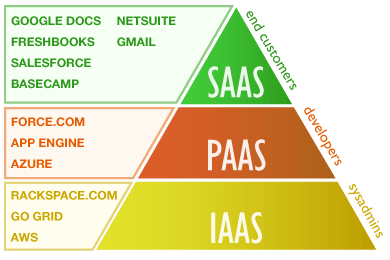
What is Infrastructure-as-a-Service?
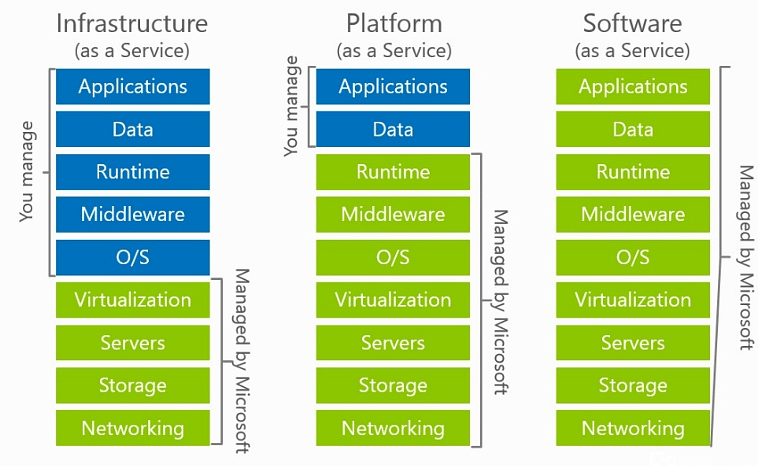
Cloud computing can be broken down into three cloud computing models. Infrastructure-as-a-Service (IaaS) refers to the fundamental building blocks of computing that can be rented: physical or virtual servers, storage and networking. This is attractive to companies that want to build applications from the very ground up and want to control nearly all the elements themselves, but it does require firms to have the technical skills to be able to orchestrate services at that level. Research by Oracle found that two thirds of IaaS users said using online infrastructure makes it easier to innovate, had cut their time to deploy new applications and services and had significantly cut on-going maintenance costs.
What is Platform-as-a-Service?
Platform-as-a-Service (PaaS) is the next layer up as well as the underlying storage, networking, and virtual servers this will also include the tools and software that developers need to build applications on top of: that could include middleware, database management, operating systems, and development tools.
What is Software-as-a-Service?
Software-as-a-Service (SaaS) is the delivery of applications-as-a-service, probably the version of cloud computing that most people are used to on a day-to-day basis. The underlying hardware and operating system is irrelevant to the end user, who will access the service via a web browser or app; it is often bought on a per-seat or per-user basis.
Cloud computing benefits
The exact benefits will vary according to the type of cloud service being used but, fundamentally, using cloud services means companies not having to buy or maintain their own computing infrastructure.
No more buying servers, updating applications or operating systems, or decommissioning and disposing of hardware or software when it is out of date, as it is all taken care of by the supplier. For commodity applications, such as email, it can make sense to switch to a cloud provider, rather than rely on in-house skills. A company that specializes in running and securing these services is likely to have better skills and more experienced staff than a small business could afford to hire, so cloud services may be able to deliver a more secure and efficient service to end users.
Using cloud services means companies can move faster on projects and test out concepts without lengthy procurement and big upfront costs, because firms only pay for the resources they consume. This concept of business agility is often mentioned by cloud advocates as a key benefit. The ability to spin up new services without the time and effort associated with traditional IT procurement should mean that is easier to get going with new applications faster. And if a new application turns out to be a wildly popular the elastic nature of the cloud means it is easier to scale it up fast.
Cloud computing advantages and disadvantages
Cloud computing is not necessarily cheaper than other forms of computing, just as renting is not always cheaper than buying in the long term. If an application has a regular and predictable requirement for computing services it may be more economical to provide that service in-house.
Some companies may be reluctant to host sensitive data in a service that is also used by rivals. Moving to a SaaS application may also mean you are using the same applications as a rival, which may make it hard to create any competitive advantage if that application is core to your business. And of course, you can only access your applications if you have an internet connection.
Types of clouds.
1) Public clouds
2) Private clouds
3) Hybrid clouds
What is public cloud?
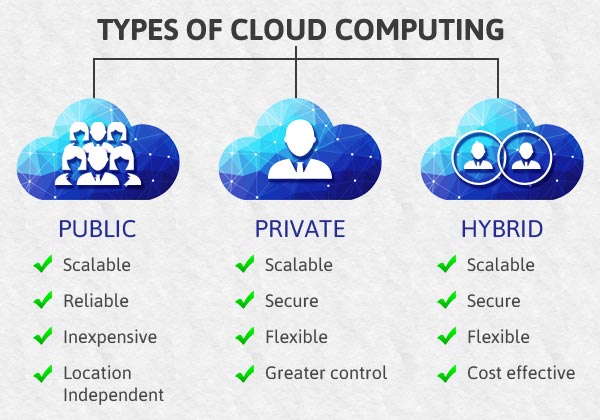
Public cloud is the classic cloud computing model, where users can access a large pool of computing power over the internet (whether that is IaaS, PaaS, or SaaS). One of the significant benefits here is the ability to rapidly scale a service. The cloud computing suppliers have vast amounts of computing power, which they share out between a large number of customers the ‘multi-tenant’ architecture. Their huge scale means they have enough spare capacity that they can easily cope if any particular customer needs more resources, which is why it is often used for less-sensitive applications that demand a varying amount of resources.
What is private cloud?
Private cloud allows organizations to benefit from the some of the advantages of public cloud but without the concerns about relinquishing control over data and services, because it is tucked away behind the corporate firewall. Companies can control exactly where their data is being held and can build the infrastructure in a way they want largely for IaaS or PaaS projects to give developers access to a pool of computing power that scales on-demand without putting security at risk. However, that additional security comes at a cost, as few companies will have the scale of AWS, Microsoft or Google, which means they will not be able to create the same economies of scale. Still, for companies that require additional security, private cloud may be a useful stepping stone, helping them to understand cloud services or rebuild internal applications for the cloud, before shifting them into the public cloud.
What is hybrid cloud?
A hybrid cloud is a combination of a private cloud combined with the use of public cloud services where one or several touch points exist between the environments. The goal is to combine services and data from a variety of cloud models to create a unified, automated, and well managed computing environment.
Top cloud providers in 2020.
1) AWS (Amazon Web services)
2) Microsoft Azure
3) Google Cloud.

Thank you so much.. ❤️
 Tech blogs